Showing posts with label Thailand. Show all posts

Thursday, 20 May 2010

Bangkok in Tears

The news and pictures have gone around the world. Bangkok has been "reclaimed" by the military and the reds have torched a number of buildings, especially around Siam.

Siam used to be my home in BKK, where I would go every evening. Now it is a very different place. But unless some of my Bangkok friends, I dont loose a lot of time worrying about buildings.

I am more worried about the people, the ones who have been hurt, and I am sad about the ones who have lost their lives. The rifts in Thailand will take years to heal and the anger of the lower class will only grow.

I would like to leave you with some pictures. They are graphic. But then again, what happened in BKK WAS very graphic.


The picture of the year.

BKK in flames.


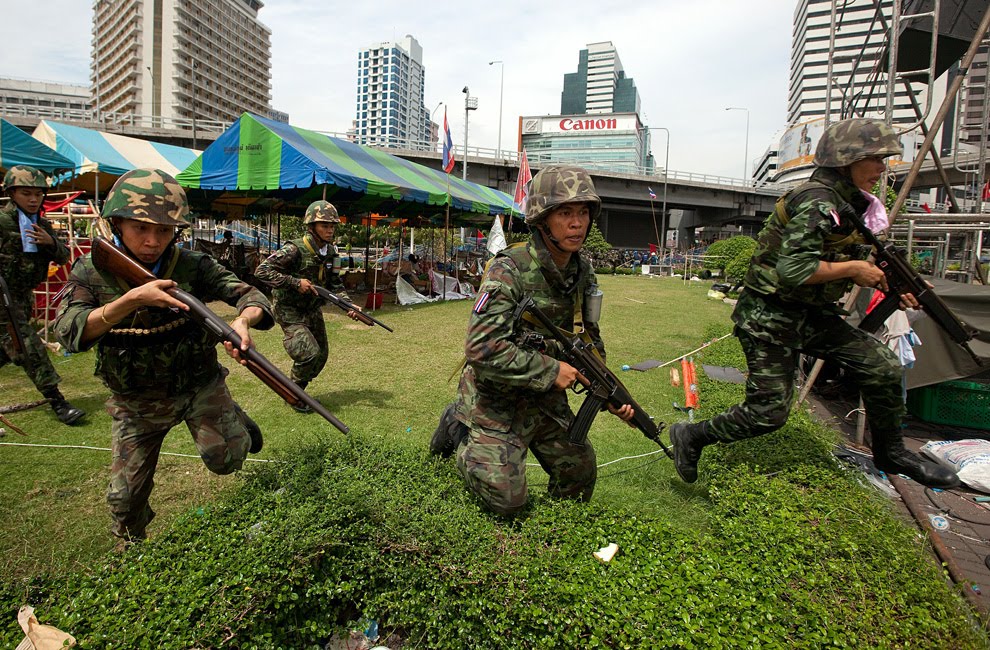
Soldiers in front of MK restaurant.

An Italian photographer sadly lost his life...

Red shirts handcuffed

The mess...


Zen burning.

An injured soldier.

Injured soldier and Canadian photographer...


A red shirt protester who lost his life.


BKK in flames.


A very strong picture, a handcuffed monk.

Soldiers advancing into Lumphini.

Soldiers followed by photographers.

No comment.


Centralworld.

Sunday, 16 May 2010

Bangkok as a War Zone

Since the last time I wrote, the situation in Thailand has turned for the worse. Where a month ago, an army attack on the demonstrators near Khao San Road and the Democracy Monument left about two dozen dead and several hundred injured, violence has now greatly spread.


It seems beyond belief but here I am looking at pictures, reading articles, messages, and maps, which all talk about Central Bangkok as a war zone. In fact, it IS now a war zone. The Army's plan is to encircle the demonstrators into a tight area from which people can not flee and into which supplies can not be brought. In the last couple of days, we have seemingly seen no positive results from the army side at all.

On the opposite: areas, which used to be considered safe are now extremely dangerous. Victory Monument and the close-by entertainment road Soi Rangnam (including the impressive King Power duty free complex) are now no-go zones. I am including a video of what is happening on this street.

The Army has positioned snipers on rooftops of strategic buildings. Red demonstrators get shot but no one knows why particular people get shot. (except the prominent shooting of Reds Army General Seh Daeng) Clearly however, all the dead are hit in the head with sniper rifles from above.

To be honest, I am confused about both sides and their motivations and actions. The Red Shirts had a deal on the table, presented by a conciliatory PM Abhisit a few days ago. It would have meant the dissolution of the Parliament within a matter of weeks and elections within months. This is what the reds wanted...they would have won the elections and been back in power. They could have rewritten the constitution and perhaps even given Thaksin a window to come back....but then they declined and started to demand silly things.

Why did they suddenly stop the cooperation and why didnt they take a reasonably good deal they could have agreed to? Do they want to motivate the countryside? Do they want to fire up their symphatisers in the rest of Bangkok? Did someone sell them out for personal gain? All I know is that the ones who have died and will die are not the ones who are leading the reds.


Abhisit on the other hand seems to have no other option. The centre of Bangkok has been occupied for weeks and the shopping malls, which belong to important people in the country want to sell goods again. After the refusal of the reds to cooperate, the PM had to act and send in troops.

But, do they have to place snipers on rooftops, where they can indiscriminately kill people? I have a feeling the Army isnt serious about taking back the main area of the demonstrators around Rajprasong because it would probably mean hundreds of deaths, including women and children.


At this stage, I cannot imagine what is going to happen next. The area of fighting is now so large and includes so many important buildings that it would seem impossible to conquer for the Army. Additionally, groups of protesters are forming again outside of the military ring, which makes the Army much more vulnerable.


While I hope for an agreement, or anything similar, which could stop at least the immediate fighting in Bangkok, I would like to share some of my thoughts and what should happen now:


-An outside team must be allowed into Thailand either under UN or under ASEAN leadership to negotiate an immediate ceasefire and a new roadmap to elections and.

-This team might have to be supported by a UN mission (military).

-In the longer term, a special envoy (see Aceh) could bring together the parties and negotiate a long-term peace deal.

-As a part of that, the constitution will have to be re-written. Thailand should become a federal state. Regional Governments should be elected by the local people. These governments will have the power to raise their own taxes and decide autonomously in policy areas such as education. There will be a national plan to redistribute tax income according to the wealth of provinces.


Unfortunately this is not what is going to happen. The Thai people, especially the Bangkok elite are too proud to let foreign people help them find a solution in this impossible situation. They still have the feeling that Thailand, as a "sovereign country" can control its situation internally. Romantic and naive notions of the Country of Smiles and the great City of Angels are still circulating. Unfortunately, we need to look at the reality and there, I think that the notion of a functioning state with rule of law does not apply to Thailand/Bangkok anymore.


I have seen pictures of people who got arrested and read twits of people who said they are being imprisoned for 6 months without parole. (unfortunately hardly anything is written about what happens to the imprisoned...) Now, Abhisit threatens the demonstrators in Rajprasong that they will be imprisoned for terroristic acts for two years.


Here, the Western world has of course set a wonderful precedence with its terrorism laws and the ubiquitous American rhetoric of “terrorism”. In fact, most people camping in central Bangkok would hardly be terrorists. Paralysing the centre of your capital for two months is hardly acceptable and setting fire to banks and other buildings is also not a noble act. Someone should be held accountable for such actions.

But someone also should have been held accountable for the airport blockade in late December 2008. Those who shout the loudest now and triumphantly argue that the “poor reds” lose work because of their protests would have proudly supported the “yellows” when they shut down air travel in Bangkok.


All in all, this shows that the Thai state is NOT able to guarantee that lawfulness, fairness and equality are practiced. There are too many actors with interests and too many people who primarily look for themselves, and in that, I think I can understand the frustration of many Thais.

The real damage to the society and country however will only surface after the dust over Central Bangkok will have settled and the last rounds will be fired. If the military is successful in suppressing the demonstrators and many more people die, I fear we will see large-scale uprisings, mostly in the countryside (Isan and North). Millions of red shirt supporters also live in Bangkok...It would be devastating and a parallel state (a very fragile one) could develop. This opens the door to all sorts of violence and irregularities. Policing would be impossible, travel would be difficult and trading too.


Whatever happens, the ruptures that run through the Thai society are larger than ever. The mistrust is so large I doubt people can live together peacefully anytime soon. I have also been shocked at the hateful and radical words which friends of mine (mostly middle-to-upper class Bangkokians) have been using. “Hate” is widely spread and is a common word for describing “the other side”. It’s all black and white.

The red shirts threaten the middle-to-upper class Bangkokian's lifestyle of superiority, nonchalance and arrogance. Whoever has been to Bangkok or lived there will know what is meant. Thailand is a class-based society and the top has done all it could to suppress the bottom. It is ironic then that the Reds have chosen to occupy the space next to Centralworld, the largest mall of BKK…


In a way then, none of what is happening is surprising. The price however will have to be paid by the commoner...and I fear THAT is not going to change, even after the current situation.

Tuesday, 27 April 2010

Thailand in Tatters

Thailand is in the news again, day in and day out. And as always in the last couple of years, it’s not for the good reasons. I moved to Bangkok post-coup and post-election so I saw Samak, the elected prime minister being chased away by the courts for cooking on TV and his successor, Somchai Wongsawat being chased away by the PAD yellow shirts and the courts essentially for being Thaksin’s brother-in-law.

I was in Bangkok when the airport was closed for over a week and suddenly, the streets were full of tourists and the shelves on the supermarket started to thin out slightly. I was also in Bangkok when the red shirts burnt tyres throughout the Bangkok old town and had their little stand-off with the military on Songkran last year.

Through all these times, whenever BBC started their news at the top of the hour with another “anti-government protesters in Bangkok…” snippet I felt a bit honoured to be so close to world-news but also increasingly uneasy that my adapted home, Bangkok and Thailand’s reputation as a whole had slowly been falling. Thailand continued to be a popular destination for travelling, a reputation that is hard to lose.

But now, I feel, things are slowly changing. What we have been seeing in the recent days (me from the distance in Australia) is a different ballgame. This time around, it’s serious. This is not about a few hundred or thousand people being paid by Thaksin to attend a rally anymore, this is about a much bigger issue.

To explain the issues that lie at the heart of all problems, I need to write about some basic issues of Thai history and identity. I take my information from some books and articles by academics, but most of all from my personal experience in Thailand.
Firstly, it needs to be said that Thailand is not alone in its struggle. Throughout Southeast Asia, indeed also Northeast Asia and other parts of the world, there has been civilian unrest during the time of democratisation, often to do with class, religion or ethnicity-based discrimination.

Basically, Thailand is still a feudal state. Very few own very much and the great majority own rather little. When the economy is going well and Thailand can export and gets a lot of incoming tourists, the great majority can also benefit, but the great beneficiaries are the very few rich people.

But the very few rich people do not just enjoy economic benefits, they also enjoy other privileges. The great majority of people and the small minority of people live totally different lives. For the great majority, a step up the ladder of wealth is unthinkable and vice versa too. You are born into a class and that’s it. Les jeux sont faits.

The Thai state however is not only rigid in terms of class but it is also an extremely nationalist and unitary state. Early in the 20th century, Thai nationalism was spurred by proclaiming the three pillars of religion, language and the monarchy as the basis of the Thai nation. Understanding these three pillars, and understanding certain limits of the pillars is at the base of understanding parts of the crisis Thailand is currently in.

The Thai nation, as is commonly taught in schools and shown in the National Museum has never existed as such. The Thai people are originally a mix of different tribes from Southwest and South China, Khmer, Malays and many others. As such, they not only look very differently, but they speak different languages, eat different foods and believe different things.

The Thai state however has for decades lulled everyone under the same tent and given everyone the same identity. It has done so quite successfully and Thailand today, is what social scientists would call a model of an “imagined community”. The great majority of things that hold Thailand together have been artificially created by the state. On top of that, myths are being created, to make everyone believe the common history. This results in people being made into someone they aren’t.

Another factor is education. Education in Thailand never teaches a student to be critical. Instead they are taught to believe what a person of authority tells them. This then applies to practically all situations in life. Responsibility is given away quietly and people who carry more respect (due to age, ethnicity or other social standing) are followed blindly. (in Thai: pu yai)

Even at Chulalongkorn University, the self-proclaimed “pillar of the nation” , the development of own thoughts and processes of reasoning are not taught and as a result of that, not even the brightest of the nation can question the status-quo.

Unless serious changes in the Thai nation occur, and unless Thai people, especially the so-called “elite” starts to learn to question societal norms, Thailand, in my opinion, cannot come to a peaceful and lasting solution.

I don't think however that Thaksin can be the answer. He is again a person of respect, to whom everyone can easily give his or her responsibility. He is an ersatz pu yai to whom people can look up to. Additionally, his motivations are far from clear and there is at least a little bit (if not a lot) of selfish thought being his bid to come back to Thailand.

The current situation in Thailand then, with the reds blocking the Rajaprasong intersection in the centre of Bangkok and having erected a bamboo-guarded camp at Lumphini park vis-à-vis Silom is not a good one. The reds want elections, and soon. But who will ensure that once a “red” candidate wins, the royalist PAD will not come out and block Bangkok again? After all, the reds would have secured an election by paralysing Bangkok. This would serve as precedence for years to come (as the airport blockade by PAD already did).

The military in the meantime is torn and cannot afford a bloodbath or a coup if it wants to remain a credible actor. The government finally cannot afford a blockade that will last much longer either and if elections are held, will probably lose. Were it to launch a violent attack on the demonstrators with the help of the military, it would be even more popular and the reds would regroup in the northeast and north, not only making a fair election impossible but seriously challenging the territorial unity and legitimacy of the Thai state.

The situation is very tense, but is further aggravated by the fact that Thais can be very emotional people, who can from one moment to another, lose all reasoning and engage in foolish acts of brinkmanship. It might only take one silly person throwing a stone or a grenade and more people die, triggering an uncontrollable chain reaction.

I am afraid to say but there is no face-saving solutions for everyone in sight. A pawn will be sacrificed and whether that is Abhisit and his government or dozens, or even hundreds of red shirts remains to be seen in a very near future.
Neither however is what should happen. Change starts in the minds of the people and what needs to happen, is more than just an election (Abhisit said this too, but I am not sure he means what I mean).

A matter of fact is that most Thais feel that they have no power and no say whatsoever in their lives. Deals are struck behind their backs, involving the police, politicians or even other actors in the political and partly outside the political field. The principles of the rule of law are simply not strong enough in Thailand. Matters of law are politicised and important matters of politics are secret.

Unless the institutions become more open, more democratically legitimised and honestly start working for the people, the population is going to continue to feel alienated by the state. And unless centralised Thailand will devolve some of its power to the regions, the rural population will continue to feel distant and powerless.

On the other side, the “elite” must realise that it cannot continue to differentiate themselves from the “commoners”, the people from the regions, farmers, dark-skinned people by treating them with contempt. The privileged must understand that Thailand will become a fairer society and part of that is recognising each and every citizen as an equal, whether poor, black, Muslim or rich, Chinese and white.

As much as I hope for a peaceful solution beneficial for all Thais, I fear that we are still very far from such a solution.

Saturday, 13 March 2010

At the Thai Temple

Today, i was in for a special treat, a day at the Thai temple here in Canberra. I used to live in Bangkok before for two years, so I am quite familiar with Thailand, Thai culture and Thai people. I have never taken part at a Buddhist ritual though.

Here in Canberra, I havent quite cut my Thai links. I live with a Thai artist, a lady around 50 years old and former wife of a Thai diplomat. Now she teaches Australian diplomats Thai language and culture and decorates rooms with fabric.

This morning, she took me to the Thai temple for giving food to the monks, praying together and finally, sharing the remaining food with the community.

We were arriving late and I was directed in to give the food to the monks, while the Thai lady was finding a spot to park her car. I entered the temple and far from being looked at as a stranger they have never seen, everyone seemed happy to see me. The expression on people's faces somehow even made me feel that they had always been waiting for me and were now pleased to see me finally arrive. There was absolutely no feeling of distance or skepticism. I was instantly part of the group.


The entrance to Wat Thammadharo. Ironically the building used to host a convent...

I think this is one of the amazing characteristics of Thai people. In Western societies I often feel people need to prove themselves to be accepted as a part of a society. That can be the case in the context of personal relationships, friendships but also for the society as a whole.

In Thailand however, you are immediately given a chance. I have hardly ever felt any negativity, defensiveness or even just distance coming from people. There could be a bit of shyness, but this is not negative as such.

After having given the food to all the 5 monks, and payed them my respect with a wai, I sat down and waited for the monks to start chanting. That was the signal to pour water in a bowl to honour the deceased. Then, we started to sing prayers for 8 minutes while the monks were eating their only meal of the day.

As I couldnt sing the Thai songs, I just rested and thought of my time in Thailand and how I miss a lot of places. After the songs, we observed 5 minutes of quiet and then we could finally take the remaining food to the kitchen and share it among the community.

It was interesting to watch the community while we were all eating. There were Thai woman with local husbands, there was an Indonesian Buddhist woman with an Australian Buddhist husband, a Laotian woman with two little mixed baby boys and a Burmese man.

Everyone somehow interacted even though people didnt know each other. The numerous kids were cuddled and touched, picked up and sometimes even scolded by all sorts of other people. At some point, the lady I know just had a baby in her arms and didnt know whose baby it was. Such is the trust among the people.


The local abbot, who said I look like Elton John....

Then, there was also the abbot who came to thank me for coming. He said I should come again, congratulated me on my Thai and remarked that I look like Elton John. And then he started to sing "Candle in the Wind..."